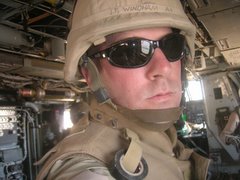
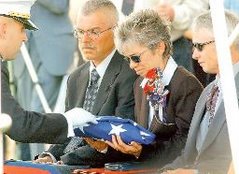
Jerrod, Aaron’s best friend, turned me on to a very important link today and I wanted to share it with any of Aaron’s brothers that may be reading. Rick Loomis shares his amazing photography and narrates the slide show from the beginning of the war through the loss of Major Zembiec. There are photos of our finest that have put their lives in danger at one time or another for all of us.
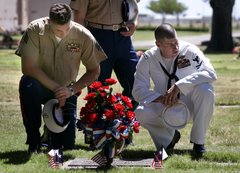
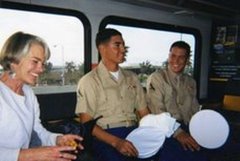
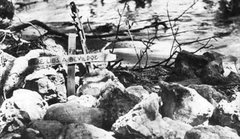
While it is of course sad, it is brilliantly done. Loomis’s talent and compassion for others are clearly evident and he shares a few photos I’d never seen before and a few are of me in Lovington as well as Doug in Sunray and Aaron’s grave in Amarillo.
I wish peace in the hearts of all my guys from 2/1 Echo company! I love you all. I’m celebrating Christmas and being with family. I hope you are doing the same. If you are not, then thank you and I love you all the more.
I pray there is much that remains for you all today, tonight, tomorrow and always.
Merry Christmas. You’re never far from me.
Semper Fi,
Deon
Click here and then click on VIEW MULTIMEDIA.
Showing posts with label OIF. Show all posts
Showing posts with label OIF. Show all posts
Monday, December 24, 2007


Friday, November 30, 2007
Success stories
Flag Gazer has up two great success stories from Iraq. Click here for news on Iraqi Army Stands Up and
Click here for news on two school openings.
Great photos too! Thanks, Flag Gazer. Flag Gazer is in our Blogrolling links and always has many articles and photos of support.
Click here for news on two school openings.
Great photos too! Thanks, Flag Gazer. Flag Gazer is in our Blogrolling links and always has many articles and photos of support.
Friday, November 23, 2007
Arm Yourself against the critics!
Angry Reader from VDH's Private Papers
Editor's Note [from National Review]: In this section we entertain letters from the critics. Some readers are angry, some are not so angry, and others merely frustrated.
August 28, 2007
I thought the Mission had been Accomplished, that major combat operations have ended, and the U.S. and its allies have prevailed. No WMD. Greeted as liberators. Stuff happens. Insurgency in its last throws. As they stand up, we will stand down. The "Plan for Victory in Iraq," that one is still on the White House website. Guess they are too ashamed to remove it, or maybe Barney the dog is in charge of the White House website. That would make perfect sense given the track record of this administration. MORE…
Monday, July 2, 2007
Michael Yon's Dispatch for July 2nd: Bless the Beasts and the Children
Mom sent this e-mail. Michael Yon is in our links. This is a great article. Thanks, Mom!
You need to read and look at the reporting done by a former military man who is reporting from Iraq on Fox titled Bless the Beast and the Children. It will make you even more proud of our Aaron and what he fought for.
+ + +
Michael Yon is an independent journalist and former Green Beret who was embedded in Iraq for nine months in 2005. He has returned to Iraq for 2007 to continue reporting on the war. Here is a portion of his latest dispatch exclusively for FOXNews.com.
Where did they go?
On June 29, American and Iraqi soldiers were again fighting side-by-side as soldiers from Charley Company 1-12 CAV, led by Capt. Clayton Combs and Iraqi soldiers from the 5th IA, closed in on a village on the outskirts of Baqouba.
The village had the apparent misfortune of being located near a main road — about 3.5 miles from FOB Warhorse — that Al Qaeda liked to bomb.
Al Qaeda had taken over the village. As Iraqi and American soldiers moved in, they came under light contact, but the real threat were the bombs planted in the roads and maybe in the houses.
The firefight progressed. American missiles were fired. The enemy might have been trying to bait Iraqi and American soldiers into ambush, but it did not work.
The village was riddled with bombs, some of them large enough to destroy a tank. One by one, experts destroyed the bombs, leaving small and large craters in the unpaved roads.
The village was abandoned. All the people were gone. But where?
As often happens in Iraq, the first time I meet American combat soldiers, we are invariably about to go off and do something serious. Although the soldiers usually do not know me from Adam, they are courteous and professional, and always watching out for me.
And so it was with Lt. Baxter, who was commanding the M-1 tank that I’d be riding along in, and who made sure I didn’t break my neck getting into the tank. I nearly pulled him off getting up, but luckily he was strong.
The tankers drove off FOB Warhorse, and only a few miles later, we arrived at the outskirts of the abandoned village.
American soldiers began unloading dozens of body bags, and the Iraqi soldiers, with grim looks, carried them into the village.
Capt. Combs has been fighting hard in Diyala for about 10 months, much of it side-by-side with Iraqi soldiers from the 5th Division. Each time I’ve come into contact with the 5th, they seem better than the rest, and American officers and sergeants who work with them have good things to report about them, saying that although the 5th still has far to go, and cannot sustain itself logistically, it can fight.
Capt. Combs said the 3-25 has never run away from combat, and never refused to close on the enemy.
“I’ve fought with 3-25 [this Iraqi unit] for 10 months in Diyala and they have always come when I am in trouble," Combs said. "They always go on patrols when I ask. They never back down.”
I asked Capt. Combs to repeat what he said, making sure he realized I was planning to quote him directly. A veteran like Combs would be unlikely to append his name to such words if he weren’t dead serious.
Capt. Combs repeated his words and stuck by them. He then demonstrated that faith when we took off into the danger zone with nine soldiers from 5th IA: just Capt. Combs, Iraqi soldiers and me.
As we passed through the village, Captain Combs pointed out the nice houses, saying the people had been simple farmers with comfortable homes and lives.
Until Al Qaeda came.
Click here to read the full dispatch from Michael Yon in Iraq.

Letters from home


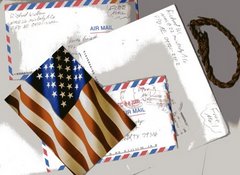
forgot to do the re-sizing on #3 when I cut out the address. This is the first time I've looked at these since I gave them to Zach in the scrapbook (photo #1). There are several letters from me in there. Most of them concern the progress of his room
Saturday, June 30, 2007
No blogging then, but I sent out quite a few e-mails
An e-mail I sent out to friends and family on April 17, 2004:
Aaron asked us to pray for the families of those fallen Marines & for the wounded. I haven't found out anything on the wounded, but I do know that from the types of wounds that are possible, the fatality list could still grow from here. I know there are many Marines families to pray for. The battalion that has been hit the hardest so far is from 2/4. (When the 12 were killed). Aaron's unit is 2/1 Echo. His unit comprises of approx. 150 Marines, but others may be attached to them, or they could possibly be attached to other units. Aaron's battalion would probably be about 500-600 in numbers. I'm not sure how large a regiment is. Maybe a part of Aaron's address would help sort this out for any of you who are interested in numbers.
2/1 Eco. WPNS 2=2nd Battalion 1=Regiment E= Echo Company (from the phonetic alphabet) & WPNS= Weapons Platoon, so, Battalion=500-600 (I'm guessing this from my Army Days), Regiment=I have no idea, probably Uncle Bennie or Uncle Lonnie knows this, Eco=approx 150, and the Platoon size (WPNS) is around 20-30. From there the elements of squad & team come. Aaron's team is 4, with him being the team leader. The Marines have quit listing the exact cause of death, as they do not want the enemy to know what worked and what didn't. They either say enemy action or show that it is another thing unrelated to enemy action. They also list the deaths in the Province, in this case, I think it is like Al Anbar, or something like that. Deaths through April 14 from 2/1 are:
PFC Sandoval from Houston, TX
LCPL Frank from Elk Grove, Ill.
CPL Matula from Spicewood, TX
LCPL Zurheide from Tucson, AZ
LCPL Shuder from El Dorado, CA
Their ages range from 18-20. They have all died due to enemy action. Sandoval died on the 6th, the others after. I know that one firefight that Aaron was so upset about that went on for over an hour was on the front page of the Lubbock Avalance Journal. I forgot to go get this paper. If anyone has this copy, do you mind sending me the article/and or picture? Most of the stuff for his scrapbook I get from the Internet, Hobbs News Sun, Albuquerqe Newswhatever, and Time Magazine puts out some good info on Fallujah.
Well, most of you probably weren't interested in this numbers thing, but it may help you to know how close it does come to Aaron by understanding this. Only on the Camp Pendleton news have I been able to trace it down as close at Platoon size. Most news just gets to Bn. size, and much more rare is down to company (Echo/or Eco.)
Everyone have a good weekend! I have parents that are both sick--the seriousness unknown at this time, but please pray for them if you don't mind. Mom has an infection in/on her leg, and Dad has a tumor on a lymphnode on his neck. I take him to a specialist on Thurs. and I guess from there they will do a biopsy. But I'm fine and I appreciate each and everyone of you. More than you can ever know...and if any of you have a special prayer request, please send it to me, as I find myself praying quite a bit these days.
Love to all,
De'on
Saturday, June 23, 2007
Good news!
One-Time Iraqi Insurgents Now Helping U.S.
Saturday, June 23, 2007
BAGHDAD — Two months ago, a dozen Sunni insurgents — haggard, hungry and in handcuffs — stepped tentatively into a U.S.-Iraqi combat outpost near Baqouba and asked to speak to the commander: "We're out of ammunition, but we want to help you fight Al Qaeda."
Now hundreds of fighters from the 1920s Revolution Brigades, an erstwhile Sunni insurgent group, work as scouts and gather intelligence for the 10,000-strong American force in the fifth day of its mission to remove Al Qaeda gunmen and bomb makers from the Diyala provincial capital.
Little so well illustrates the Middle Eastern dictum: "The enemy of my enemy is my friend."
And as it struggles in the raging heat and violence of central Iraq, the U.S. military appears to have bought into the tactic in its struggle to pull what victory it can from the increasingly troubled American mission in Iraq, under congressional pressure for a troop pullout and a presidential election campaign already in the minds of voters.
Each U.S. Army company in Baqouba, an hour's drive northeast of Baghdad, has a scout from the Brigades, others have become a ragtag intelligence network and still others fight, said Capt. Ricardo Ortega, a 34-year-old Puerto Rico native of the 2nd Infantry Division.
U.S. commanders say help from the Brigades operatives was key to planning and executing the Baqouba operation, one of a quartet of U.S. offensives against Al Qaeda on the flanks of the Iraqi capital.
The informants have given the American troops exact coordinates of suspected Al Qaeda safe houses, with details down to the color of the gate out front, said Lt. Col. Avanulas Smiley, 40, commander of the 1st Battalion, 23rd Infantry Regiment and a Tacoma, Wash., native.
Most of the Brigades members, whom U.S. officials call "concerned local nationals," hail from eastern Baqouba, while the bulk of the fighting has so far raged in western Baqouba.
But with contacts among fellow Sunni fighters on the city's west side, they have fed American soldiers critical information about Al Qaeda positions.
The American decision to bring insurgents into the mission has angered Shiite Prime Minister Nouri al-Maliki who told visiting Defense Secretary Robert Gates last week that the tactic — getting too cozy with former enemies — would backfire.
But U.S. officials defend the strategy, first tested in Iraq's once-volatile western Anbar province, where U.S. officials tout success in turning Sunni tribal leaders against Al Qaeda.
"We've given them a little ammo, some flares, but mostly humanitarian aid. We're not arming these guys, we're just changing the direction they're pointing their guns in," said Lt. Gen. Raymond Odierno, the U.S. ground forces commander, who made a one-day visit to the Baqouba battlefield this week.
U.S. commanders turned down the Brigades members' request for ammunition when they straggled into the U.S. post in Buhriz two months back. American intelligence spent weeks vetting the volunteers before they started lining them up for the operation that opened in the early hours Tuesday, said Command Sgt. Maj. Jeff Huggins, a 41-year-old Honolulu native of the 2nd Infantry.
Despite intelligence checks, there is concern that some of the Brigades men, or people close to them, tipped Al Qaeda to the coming offense. Odierno said 80 percent of Al Qaeda leaders managed to flee the city before American soldiers stormed into Baqouba before sunrise Tuesday.
The troops found roads with buried bombs and booby-trapped houses across the city.
The men who first contacted American forces in April had been picked up by Iraqi police after a bloody gunfight in nearby Buhriz, and taken to a joint U.S.-Iraqi outpost, where they asked to speak with U.S. military officials.
Al-Maliki complained that the U.S. was turning them and other Sunni insurgent groups into nothing but better trained and armed Sunni militias that will torment the Shiite population and turn their guns on Iraqi troops and police once U.S. forces leave the district.
The group says it abhors the killing of Iraqi security forces, and a commander, speaking on condition of anonymity out of security concerns, said his group turned against Al Qaeda over just that issue.
"We do not kill police or army members, or call for their killing," he said. "Al Qaeda threatened us for taking this stance. ... They began to kidnap and kill our fighters, so ... we began to fight back."
That leaves open whether the men will revert to form — their history of killing American soldiers. The commander would not address this.
The commander said his group had turned down a previous request from U.S. officials to join the fight against Al Qaeda.
"But after recent killings among our Iraqi people in the province, we decided to fight alongside Iraqi and American troops," he said.
Maj. Gen. Abdul Karim al-Rubaie, an Iraqi army commander who works at a U.S.-Iraqi operations center for Diyala province, said his troops are comfortable working with the 1920s scouts.
And he suggested that help from the Sunni insurgent group could lend legitimacy to the Shiite-dominated Iraqi security forces in the area. Baqouba's civilian population is majority Sunni.
"I've found them very beneficial — they've helped us in Buhriz and Tahrir (neighborhoods of Baqouba)," said al-Rubaie, a Sunni. "They're fighting on the side of the Iraqi army with enthusiasm, and without requesting a lot of money or weapons."
To U.S. officials here in Baqouba, the Brigades members offer a window into Sunni divisions where American forces can apply pressure.
"They're grassroots, organized — even like neighborhood firemen — and they've decided they want a safe environment," said Brig. Gen. Mick Bednarek, deputy operations commander for the Army's 25th Infantry Division. "Will we leverage that? Darn right we will. And is it a potential risk? Sure it is — but it's one we're willing to take."
from FOXNews.com
Monday, June 11, 2007
We can't miss this show!!

I’ve taken the liberty of lifting Dave’s post from My Point. It sounds as if this will be a great show. I plan on listening, so hopefully you’ll be there too!
Here’s Dave’s post.
Tonight 9:00 PM Eastern Jenn and I are honored to have Marine Captian and now author on the air with us tonight.
David J. Danelo (click the link for David's website) doesn't write about himself a Marine Captain, but writes about the "grunts", the men that run the Corps. Find out what "Disorder" and leading the "Spartan Way" during OIF II and battle in Al Anbar, Fallujah, and Haditha. Fantastic book about Marines in urban warfare that is current today in Iraq.
I am still reading Blood Stripes and I encourge all of you to go to your favorite book store and read this outstanding book by one of us, a Marine and American warrior!
Listen live tonight here: 9:00 PM Eastern and 6:00PM Pacific.
And you should read the reviews and buy David's book here, NOW!!
If you have been wanting to better understand the war in Iraq this book will give you an excellent foray into Iraq and maybe even a couple of reasons why we went there to fight the terrorists!
 HOPE TO 'HEAR' YOU THERE TONIGHT!
Semper Fi,
De'on
Subscribe to:
Posts (Atom)