Showing posts with label OIF history. Show all posts

Monday, January 28, 2008

Fallujah Pride

Iraq Journal: The Final Mission: Part One

Click here for this article on FOXNews.com


Michael J. Totten
Iraq Journal: A skeleton crew of a mere 250 Marines is all that remains as the United States wraps up its final mission in what was once Iraq's most violent city.

Saturday, January 26, 2008

Saturday Stuff

Ray let me know about the book, Whiskey Tango Foxtrot: A Photographer's Chronicle of the Iraq War which is by Ashley Gilbertson.


Other reads concerning Fallujah that may be of interest to our Marines and readers are

Three Block War II: Snipers in the Sky (which I have just now accidentally deleted the photo of) by Matt Ziegler

and
Fighting For Fallujah: A New Dawn for Iraq by John Ballard

And something Ray told me about a long time ago that I’ve failed to check out (I know you're surprised that I'm behind--yes, on even the things I care so much about) but I think some of you may already know is that Bing West and his son (I think it’s his son) are planning on making a movie out of No True Glory.

Ray has shared some of the details with me before (that are filed away in a file that is quite long!!) so please, Ray, for our readers and the little editor here, can you share those details with us again as well as the link? Or anyone else that may have info. I think quite a nice line-up of actors are already picked to star in this movie!

Hope everyone is having a great Saturday and it’s good that it’s a little warmer here. I’m just kicking around on a lot of this and that. How ‘bout you?

There are still some blogs I plan on visiting before this weekend is out. It was good to do that last night. What an awesome bunch of bloggers we’re linked to!

Semper Fi,

De’on

Friday, January 25, 2008

Semper Fi Mom's happy!

Semper Fi Mom tells me that Steven, Marine son # 1, is back on U.S. soil. Marine son #2 is stationed in North Carolina as well and so was able to meet his brother upon arrival. The Semper Fi Family in Lubbock now awaits #1 Son’s arrival for sweet, sweet leave. It’s my hope that I’ll get to meet Steven, even if briefly, during his short time home.


SFM said that he was “happy to be back and wanting Mexican food and that it was weird to see Marines in green cammies, evergreen trees, and working intersections.”

Thank you, SFM and much thanks to Steven for his service in Iraq, and to Father God for bringing him home! I know the party in Lubbock will be a big one! BELOW IS AN ARTICLE CONCERNING THE COMMAND'S RETURN.

After you read what Marine son #1 has been up to, then check out the article on the Ospreys. Marine son #2 spends his time with these creatures!

+ + +

RCT-2 command element returns to Lejeune

Staff report
Posted : Wednesday Jan 23, 2008 12:32:03 EST

CAMP LEJEUNE, N.C. — The command element of Regimental Combat Team 2 is expected to arrive here today after a 13-month deployment in Iraq.

Throughout its third combat deployment, RCT-2 conducted counterinsurgency operations in western Anbar province. The roughly 350-man regimental headquarters initially directed operations in an area of more than 30,000 square miles; it later burgeoned to 50,000 square miles, including a 210-mile border with Syria, according to a II Marine Expeditionary Force press release.

Nearly 15,000 Marines, sailors and soldiers and 11 infantry battalions rotated through western Anbar under RCT-2.

The remainder of the regiment is expected to return later this month.

Camp Pendleton, Calif.-based RCT-5 took over from RCT-2 during a transfer of authority ceremony Tuesday.

During the ceremony, Col. Patrick Malay, commanding officer of RCT-5, assumed control from Col. Stacy Clardy, commanding officer of RCT-2. Malay is returning to Anbar after commanding 3rd Battalion, 5th Marines, during the Battle of Fallujah in 2004.

RCT-5 will continue the training and mentoring of the Iraqi Security Forces and provide assistance to local governments and citizens. The regiment will also oversee the military, police and border transition teams in western Anbar, officials said.

Click here to read “Higher, Farther, Faster: Ospreys in Iraq" featured in Military.com

Semper Fi!
De’on

Friday, January 18, 2008

Boot Camp Graduation-Jan 18, 2002
E-mail from USS Rushmore-Jan. 18, 2003

+ + +
God Calling-January 18
Faith - Works

Pray daily for Faith. It is My Gift.

It is your only requisite for the accomplishment of mighty deeds. Certainly you have to work, you have to pray, but upon Faith alone depends the answer to your prayers - your works.

I give it you in response to your prayer, because it is the necessary weapon for you to possess for the dispersion of evil - the overcoming of all adverse conditions, and the accomplishment of all good in your lives, and then you having Faith, give it back to Me. It is the envelope in which every request to Me should be placed.

And yet "Faith without works is dead." So you need works, too, to feed your Faith in Me. As you seek to do, you feel your helplessness. You then turn to Me. In knowing Me, your faith grows - and that faith is all you need for My Power to work.

"Behold, his soul which is lifted up is not upright in him: but the just shall live by his faith." - Habakkuk 2:4

"Now unto him that is able to do exceeding abundantly above all that we ask or think, according to the power that worketh in us." Ephesians 3:20

blessings to you and yours this day and always ...
www.twolisteners.org

Friday, December 7, 2007

More

Flag Gazer sent us these links as she promised in her comment on the powerful piece Hope Rides Alone written by SGT Eddy Jeffers. Thank you so much, FG. I’m so sorry for this nation’s loss and so very sorry for your own personal loss out of this. I know you’ve sacrificed a great deal and still manage to support so many troops.

Click below for this great share.

1. Freedom Feels Good

2. The Real Deal in Ramadi

3. Eddie's Dad pays tribute

Thursday, November 22, 2007

Articles worth reading, re-reading, re-printing....

Our New National Divide

Owen West
September 13, 2007

Last month I was running the Central Park loop when a runner wearing a U.S. Marine Corps shirt approached. I alerted the two boys in the jog stroller and my eldest, who met this world with a father in Iraq, shouted, "Semper fi!"

The man saw the emblem on my visor and said, "You hear about Doug Zembiec?" If most Americans have six degrees of separation, Marines have no more than two. I nodded and stopped my watch. But all he managed to say was, "That one hurt." Then he plunged down the hill toward 72nd Street, cutting his own path against the flow.

I tried to make sense of it. Not the encounter but the sheer madness of the surroundings. Runners were chattering about school applications and subprime predictions. Yet most of them told pollsters that Iraq was the single largest anxiety in their lives. Like the majority of the nation, they were exhausted by a war in which they had no role. And they wanted out. MORE.

***


November 12, 2007, 0:00 a.m.

Slandering the American Soldier
An American media tradition.

By Mackubin Thomas Owens

As anyone who has not been vacationing on the moon knows, The New Republic embarrassed itself this summer by publishing and defending a series of stories by one Scott Thomas Beauchamp, an active-duty soldier serving in Iraq. As we know, Beauchamp told of his comrades in Iraq mocking a woman horribly scarred by an IED, wrote of another wearing part of a human skull, and depicted yet another using a Bradley fighting vehicle to run over stray dogs. All of the stories have been discredited.

There’s not much I can add to the substance of the story. But what bothers me most about the whole dishonorable episode is what it says about the attitude of the media toward the American soldier. There is, as I have argued before, a troubling predisposition on the part of the press to believe the worst about those fighting in Iraq and Afghanistan. There is plenty of talk about supporting the troops, but it is a sham. MORE...


***

I think you'll like these or maybe you've already read them. They are good.

Talk to you later!


***

Tuesday, June 26, 2007

N.M. soldier killed in Iraq shortly before return home


by FELICIA FONSECA Associated Press
June 24, 2007

Los Lunas grad joined military soon after high school

ALBUQUERQUE — A New Mexico soldier, who was scheduled to return home just days after the birth of his son, has died in Iraq.

Army Cpl. Joel Dahl, 21, died during small arms fire Saturday near Baghdad, said his stepfather, Joe Aragon, who has raised Dahl since he was about 10. He was one of seven U.S. troops killed by roadside bombers. An eighth soldier died of a noncombat cause.

Aragon said doctors are planning to induce labor on Dahl’s wife, Alia, on Friday. Dahl was set to leave Iraq on July 2.

“She wanted to surprise him with his baby when he got here,” Aragon said.

The Dahls, who were married last September, already had picked out a name for their baby boy — Kayden Anthony — which they came up with by looking through a book of baby names.

Dahl also liked the name because it meant his son would have the same three initials as his wife, although not in the same order.


When the couple first met in church, Aragon said Alia couldn’t stand her husband. But he was determined, Aragon said, to get the girl he fell for. “When he finally got to talk to her, he charmed her over,” Aragon said.

Alia is having a “very hard time” coping with her husband’s death, and Aragon said the family is trying to keep her as calm as possible. “But given the circumstances, it’s hard,” he said.

Dahl graduated from Los Lunas High School, where he was a part of the school’s ROTC program, and joined the military soon after.

Aragon said Dahl planned to use that experience as a stepping stone into law enforcement.

“He was just the kind of person where he liked being in public service,” Aragon said. “He was a person that liked helping other people.”

Even when it came to boosting his stepfather’s dragon collection.

Dahl had called his wife the day before Fathers Day and asked her to find “something special” for Aragon and to keep in mind his admiration for dragons. “He had her running all over the place,” he said.

What she came up with, Aragon said, was a “beautiful little lamp” with a dragon painted on it. “I was all excited about it,” Aragon said.

He and his stepson talked a day or two later, and Aragon said he let Dahl know the only thing he didn’t like about the call was that it came at 2 o’clock in the morning.

In Iraq, it was noon.

“That was pretty much the last time I talked to him,” Aragon said.


Tuesday, June 19, 2007

Tomorrowland 1


Since my return to Iraq, I’ve been working to rebuild a war-torn country. Here’s what life as a captain with the 451st Civil Affairs Battalion looks like.
by Jonathan Moss

We celebrated Christmas by heading to an M240 machine-gun firing range outside Najaf (from left, me, Major Greg Scott, Corporal Mike Darling, and Sergeant Sterling Oyadomari). It was a good time. I’d never fired an M240B machine gun before, but I got the hang of it with the help of some very experienced noncommissioned officers.


Texas Monthly March 2006

Tomorrowland 2


Top Left: Our chow-hall cooks are mostly from India, and the American food they prepare tastes like, well, like it was cooked by people who don’t know what it’s supposed to taste like. My most recent (and happy) discovery is that they also prepare Indian food, so I’ve started to opt for that.

Bottom Left: The M240B fires several hundred rounds per minute, and you try to walk the rounds right up to the target. It’s more difficult than you’d think, because the Humvee is moving and bouncing around. We practiced in an area called the Najaf Sea. The sand is mixed with tiny seashells everywhere you walk, and there’s water ten meters underground.

Top Right: In Najaf there are vendors who sell decorative strands of flowers. I’ve seen the flowers on cars, and some soldiers have bought them to decorate with. They’re a strange sight in a city where the ground outside every home is a place to dump trash.

Bottom Right: There’s always an Iraqi interpreter with us wherever we go (from left, Major Scott, me, and our interpreter at a construction project in the village of Suq Shalan). Interpreters are critical to our success in Iraq. They and their families endure continual threats against their lives, But many of them feel that by helping us they are serving their country.


Texas Monthly March 2006

Tomorrowland 3


Top Left: I was on the roof of Najaf’s newly constructed Al Tabary Primary School, checking its tiles and drainage quality, when I heard kids yelling. I asked the contractor what they were yelling, and he said, “Thank you! Thank you!” Later my interpreter told me that they weren’t saying that at all; they were asking us to renovate their school, next door.

Bottom Left: Armored Humvees save lives, but they give a false sense of security, because IEDs can still penetrate them. eventually a soldier realizes that when it’s his time to go, it’s his time to go. It’s a quasi-spiritual perspective, where you simply accept the randomness of who gets killed and when.

Top Right: In my job I frequently deal with local authorities. The mayor and a city council member from Al Kifl, a town on a military supply route between Najaf and Baghdad, often visit with me and my interpreter to discuss the clashes between their citizens and the fast-moving convoys. I do what I can to maintain good relations, but I’m also careful not to get led around by the nose.

Bottom Right: The cans we live in are basically shipping containers with doors and air-conditioning. But we do have a library, a small movie theater, a gym, and phone and Internet centers. My favorite comfort is the laundry service: My clothes are washed and folded in 24 hours.


Texas Monthly March 2006

Tomorrowland 4


I check my e-mail in one of our offices. It’s great to be able to receive news from home, and it’s also nice to shop online. (I can order books or DVDs or clothing, and they get here in a few weeks.) Some soldiers even use the network to make calls over the Internet. It makes me think of the words in that U2 song—“far away, so close.” This poses some difficulties for the military, which must balance between offering a system that’s good for morale and controlling the information that’s vital to operations. And there’s little doubt that our enemies are technologically advanced: They’ll publish videos of IED and sniper attacks on their Web pages, and sometimes the footage is synchronized with Arabic music urging you to join the jihad. In today’s world, not only do we have to be competent at shooting wars, we also have to learn to fight the information war.

Captain Jonathan Moss, of Paris, has been chronicling his tour in Iraq for Texas Monthly since August 2005. To read his previous installments, go to texasmonthly.com/authors/jonathanmoss.php.
Texas Monthly March 2006

Saturday, June 16, 2007

Pick Your Mail Service!!

WASHINGTON — Turns out the trouble at Walter Reed Army Medical Center, the focus of a firestorm of criticism over poor treatment of wounded war veterans, reached into the mailroom.

The Army said Friday that it has opened an investigation into the recent discovery of 4,500 letters and parcels — some dating to May 2006 — at Walter Reed that were never delivered to soldiers.

And it fired the contract employee who ran the mailroom.

In an indication of the Army's sensitivity to problems at Walter Reed, whose reputation as the crown jewel in the Army medical system was tarnished by the disclosures of poor treatment of soldiers earlier this year, officials put out a written statement late Friday afternoon detailing the problem with the mail.

Maj. Gen. Eric Schoomaker, commander of Walter Reed, said he ordered a team of 20 to 40 soldiers and civilians to launch an around-the-clock operation to screen, survey and forward all the letters and parcels. Items addressed to soldiers still at Walter Reed were being hand-delivered Friday night, he said.

Story continues here.

or this?

It was only a short-time ago that communication such as the type of MotoMail was unheard of. When Aaron was deployed the first time, I was thrilled for e-mail! And now there's this quicko letter service in which you can even add photos!

It's only right that something as eventful, historical and important for the morale of our troops be posted and tested in our upcoming test!! ;)

A log in link is provided below.

MotoMail is a service that is brought to you and endorsed by the Marine Corps which allows electronically transmitted letters to be printed in Iraq and delivered to the recipient often in as little as 48 hours. Transit time via US Mail is eliminated, allowing a much quicker delivery to our Marines in Iraq.

Friday, June 15, 2007

Military News

Air Force Reports F-16 Crash in Iraq
Friday, June 15, 2007


BAGHDAD — An F-16 fighter jet crashed Friday in Iraq, the Air Force reported, in the first such loss in more than six months. The statement said the crash was an accident, but did not say where the plane went down or what happened to the pilot.

Separately, the U.S. military announced the deaths of five American soldiers.

The loss of an F-16, a
workhorse warplane in the Iraq war, is rare. One crashed last Nov. 27 in the western province of Anbar, killing the pilot. The jet that crashed shortly after midnight on Friday was deployed to the 332nd Air Expeditionary Wing at Balad Air Base, 50 miles north of Baghdad.
"The cause of the accident is under investigation," said the statement from the Central Command Air Forces, which provided no further details.

from FOXNews.com

Wednesday, June 13, 2007

3 Things


Harold E. Hager was killed in Vietnam. He and Aaron have 3 things in common.

1. They were both Marines.

2. They both resided in Lea County.

3. They were both E-3s when they gave their lives as Marines.

The Vietnam Veterans Memorial

U.S. MILITARY CASUALTIES IN SOUTHEAST ASIA -
- DEATHS BY PAY GRADE AND SERVICE -
- REFLECTS POSTHUMOUS PROMOTIONS -

- AS OF MARCH 31, 1997 –

Since 1997 78 names have been added to the memorial as a whole that are not shown in the stats below. They are in order of: RANK/PAY GRADE USA USN USAF USMC USCG and TOTAL respectively.

E-09 52 4 41 18 0 115
E-08 190 13 34 33 0 270
E-07 987 67 64 115 1 1,234
E-06 2,233 186 136 299 1 2,855
E-05 5,133 326 228 723 1 6,411
E-04 11,528 618 247 2,322 0 14,715
E-03 12,822 645 148 4,379 1 17,995
E-02 476 68 9 5,633 0 6,186
E-01 143 3 0 379 0 525

Source

3 Flags


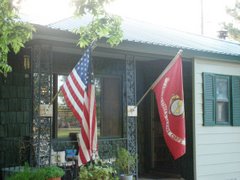
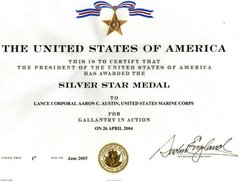
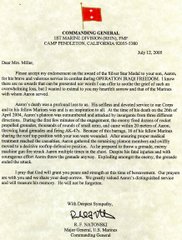
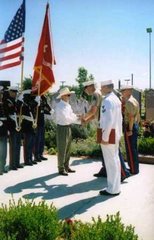
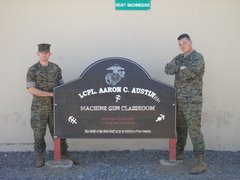
As they stand now, these 3 flags and 1 memorial honor 2 Marines. One is Major Douglas Zembiec and the other is Lance Corporal Aaron C. Austin. What was their relationship to each other? (outside of New Mexico.)

Sacrifice and the LCpl

Marine deaths in Iraq as of November 2, 2006. Source
Lieutenant Colonel (1)
Major (9)
Captain (20)
1st Lieutenant (12)
2nd Lieutenant (9)
Chief Warrant Officer (2)
Warrant Officer (1)
1st Sergeant (2)
Master Sergeant (3)
Gunnery Sergeant (11)
Staff Sergeant (40)
Sergeant (68)
Corporal (180)
Lance Corporal (344)
Private First Class (56)
Private (5)

Only the deaths of Specialists and Sergeants of the Army exceed that of the Lance Corporal of the Marine Corps. As of November 2, 2006, those numbers were Specialist (488) and Sergeant (382). Those at the rank of Staff Sergeant (250) and Private First Class (238) follow.

Tuesday, June 12, 2007

The Believer 1


The Believer


As an Army veteran who lost a son in Iraq, I felt it was my duty to go to Crawford to tell Cindy Sheehan why she’s wrong about the war—and why President Bush is right.


By Gary Qualls. [published in Texas Monthly March 2006]


I GREW UP IN HARKER HEIGHTS and went to Killeen High School. My dad was in the Army and was a professional shooter, so I grew up hunting. I enlisted in the Army in 1974. I was sent to Saigon but was there for only a few days before the war was over. Later I was transferred to a special operations unit, and after that I went to sniper school. I was a pretty good shot. I’ve been accused of knocking a gnat off a fly’s butt. I said, “No, but I got the fly.” I got out of the Army but stayed in the Texas National Guard and worked at the VA hospital here in Temple as a surgical OR tech. I volunteered for sniper duty in Bosnia in 1999 and came home a year later. Two months after I retired, we were attacked at the World Trade Center—Pearl Harbor number two. September 11 was an eye-opener. It reminded us to always keep watching.

My son Louis was born in 1984. His mother and I divorced, and I raised him and his younger brother, David, by myself. Three kids lived in this household, and I was the oldest. That’s how we lived. All three of us would scuba dive together, go fishing, hunting, riding Harleys. Louis was born into the military—I always had him decked out in cammies—and he always wanted to go into the service and be like his daddy.

He joined the Marine Corps Reserve on his eighteenth birthday and volunteered to go to Iraq four times before he was finally taken. He had just started at Temple College, and as a reservist, you can say, “I want to stay in school.” He had every excuse not to go, but he said, “Dad, I can’t let my friends go without watching their backs.” But Louis didn’t do it just for his friends. He did it for the people of Iraq, Afghanistan, and our country, as well as the people of the world. In Louis’s last letter, he said that I was his hero. Well, now he’s mine.

I’ll never forget the day we got the news. I was in the kitchen and heard a knock at the door. David answered it and said, “Dad, there are three Marines standing on the front porch. They want to talk to you.” All I could think was “No, no, don’t tell me that.” You don’t have three Marines standing on your front porch for nothing. I was already crying. I looked at them and noticed one was a chaplain. I said, “No, no, not my baby. Not my baby.” I pushed the door open, took two steps, and my knees buckled. They told me Louis had been killed in action in Fallujah.

The day I buried my son I got a call from the gunny sergeant. His whole platoon knew they owed their lives to Louis. They had been under fire, and he had run across the street, drawing the attention of an insurgent who was loading a rocket-propelled grenade. Instead of firing at the unit, he fired at my son. Louis did a great deed. He fulfilled his obligation.

Louis was the first soldier from Temple lost since Vietnam, and when he was killed, I became a member of a club nobody wants to be a member of: “gold star” families. The Army gives flags with a gold star on them to families who have lost someone in combat. After World War I, a group of mothers of fallen heroes formed American Gold Star Mothers. It’s a peaceful organization that is about honor and respect. So when I saw that Cindy Sheehan was coming to Crawford to protest against President Bush on August 6 and that she had helped start a group called Gold Star Families for Peace, I was curious. Her phone number was on her Web site, so I just called her up. I introduced myself and said, “I too am a gold star family member.” I asked if she could explain her motives for protesting at President Bush’s ranch. She got real hateful, then started saying, “Hello? Hello? We’re having a communication problem.” Then she hung up.


cont'd below

The Believer 2

So I came to Crawford on the twelfth. There were all these lesbians and gays; there was a rainbow flag flying with “We the people” on it, but I didn’t see an American flag. The Bible says don’t associate with people like that. There were also all of these unruly people, shoddy-looking, the kind of people I don’t associate with. Along a ditch, they had all these crosses up with the names of our fallen heroes on them. That ditch was unmowed, and I thought, “How disrespectful and dishonorable.”

I walked among the crosses, looking for Louis’s. I asked some of the protesters, “You don’t have my son’s cross out here, do you?” They asked who my son was. I said, “Lance Corporal Louis Wayne Qualls.” They said, “How do you spell the first name?” I told them, and two of them disappeared. A few minutes later, they came back, pulled a cross out of the ground that didn’t have a name, and stuck a cross in the ground with Louis’s name. Right then I thought to myself, “How disrespectful. You never asked me to do that.” Military tactics went off in my head; I was surrounded by Cindy Sheehan’s people, and I knew if I yanked it out, I’d have a hell of a fight. I said to myself, “I’m going to repossess it. Time is on my side, and I’ll do it when they least expect it.”

The next day I brought a big picture of my son with the words “Fallen Hero” on the top. Representatives of Cindy Sheehan saw that and asked if I wanted to have a meeting with her. I said sure. So we met and talked for about 45 minutes, mostly about what our sons had done. It was pretty civil. Then a photographer came over to take a picture. Cindy loomed over me, giving me a sad look, and then put her arms around my neck. He took the picture. I was not hugging her, but afterward I gave her a hug. Then I pulled out my camera and said, “Can we have a picture with my camera?” In that she’s smiling real big. I figured out that everything about her is cameras and the media. She gave the sad face for the news photographer, but right after, she was smiling. She’s a fake. The very last thing I said to her was “Please leave our fallen heroes out of this.” All of a sudden the hate came out of her heart. She said, “I can use my son and anybody else I want to anytime. ” I looked at her with disgust.

Two days later, the media was all over the place, and I knew it was the best opportunity to get Louis’s cross without getting assaulted. I said, “I’m going to repossess my son’s cross,” and some cameramen asked, “Can we film it?” and I said yes. I waited for them to get their gear, then walked across the street. I said, “I’m taking my cross from these unholy people.” I found the cross and pulled it out of the ground, and I was almost attacked. One man said, “That’s our property.” I said, “That’s got my son’s name on it. It’s mine.”

I drove into downtown Crawford and told some people I had repossessed my son’s cross from Cindy Sheehan’s unholy people. They set microphones up, and I bore my testimony. I said I’ll never stand for this again. Bill Johnson, who owns the Yellow Rose, in downtown Crawford, heard my testimony and said, “We’ve decided to build a place to make a stand against these people, and we’ve all agreed to call it Fort Qualls—a fort, to make a permanent stand. A camp is temporary. A fort is permanent.” I was honored. People began calling from all over the country, asking us to repossess their sons’ crosses. “Can my son’s cross stand with yours?” they asked. We repossessed about 75 over the next couple of weeks.

I have no idea why God put me in a position like this. He’s always chosen me for special missions. I kept asking God for the strength to make the right decisions, and slowly but surely I saw the rest of the U.S. stand up too. I said, “All you’ve done is wake a sleeping giant”: the silent majority of Middle America. Now I’m a spokesperson for all the gold star families. I just got back from Fort Benning. I also spoke in New York, Atlanta, and in D.C., where I met with members of Congress.

The other side has tried to label me a “war supporter.” Nobody wants to go to war, least of all the leader of our country. But a decision has to be made. President Bush made the right decision. Sometimes it hurts to make the right decision. You never want to discipline your son, but you do it. It’s the same principle. The immoral thing would have been sitting around and doing nothing. And if you do nothing, you support what’s wrong. Yet most of those protesting don’t have the conviction to fight if they don’t have to. If we answer to Cindy Sheehan’s whim and pull our troops out, who will be held responsible for the atrocities?

The death of my son brought me to a more defined, deeper appreciation—to be able to understand what others can’t. All I can do is what I’ve told my sons: Keep going, no matter what. If someone’s down, help him up. When you get too tired, ask Jesus Christ for help. Sometimes we don’t want to do things, but we have to do them. You have to learn to know the difference between your wants and your needs. That’s responsibility.

Casualty of War 1


Casualty Of War

Master Sergeant James Coons, of Conroe, was a decorated soldier who served his country for seventeen years. But when the horrors of battle took their toll, the Army he loved so dearly left him all alone to fight his demons.

by Skip Hollandsworth

Related stories...
The Unseen Enemy

MASTER SERGEANT JAMES COONS was alone in his trailer at Camp Doha, in Kuwait, standing in front of the bathroom sink, when he saw the face. It appeared in the mirror—a young soldier’s face, most of it ripped away, the bones exposed and the skin blistered with burns.

For several seconds, Coons stared at the mirror. He turned away, waited for a moment, and looked back. The face was still there, hovering like an apparition. The one remaining eye was open, unblinking, staring right back at him.

It was the spring of 2003. Coons, who was 35 years old, was about to receive a Bronze Star and a U.S. Army Meritorious Service Medal for his work installing combat communications systems during the invasion of Iraq. He was, by all accounts, a soldier’s soldier: six feet two, two hundred pounds, with a flattop, a perfectly chiseled jawline, and biceps the size of baseballs. “A real-life G. I. Joe,” one sergeant said about him. “Our Rock of Gibraltar,” added a lieutenant colonel. In just a couple of months, Coons was scheduled to return to Texas to attend an academy at Fort Bliss, in El Paso, so that he could become a sergeant major, the highest rank an enlisted soldier in the Army can achieve.

But Coons never made it to Fort Bliss. He never fulfilled his dream of leading a large battalion of soldiers and passing on to them what he described as “the joys of Army life.”

Instead, Master Sergeant Coons would soon find himself alone, stuck in a little room in a little building at Walter Reed Army Medical Center, in Washington, D.C. No one came by to check on him. No one stopped to ask about the face of the soldier that he had seen in the mirror.

And what happened next became a tragedy that, to this day, no one has been able to explain.

IT WAS CALLED “SOLDIER’S HEART” during the Civil War, “shell shock” during World War I, and “battle fatigue” during World War II and Korea. Since the Vietnam War, it has had a sophisticated medical name—“post-traumatic stress disorder”—and as doctors now know, it can cause psychic wounds in soldiers that are just as devastating as the physical wounds that come from a bullet. In many cases, it slowly worms its way into soldiers’ lives months or even years after they have returned home. But it has also been known to afflict soldiers almost overnight, plunging them inexplicably into the depths of despair. According to psychologists and neurologists, the stress of war literally changes the brain chemistry of those soldiers, causing them to fall apart emotionally and plaguing them with nightmarish flashbacks, searing panic attacks, and constant, overwhelming anxiety.

Coons hardly seemed like a candidate for such a disorder. He was not a raw, young recruit. He was one of the Army’s more experienced soldiers, a seventeen-year veteran who told everyone that he wanted to remain a soldier for an additional twenty years. “He was willing to do anything for the Army,” says his mother, Carol Coons, a gentle-looking woman with highlighted hair. Sitting next to her husband, Richard, at the kitchen table in their home in Katy, outside Houston, she digs through a large cardboard box that is filled with letters, e-mails, photos, certificates, and government reports documenting James’s life. “Look, here is one of his commendations for marksmanship,” she says. “And here is his commendation he received when he completed Air Assault School.” She leafs through more papers. “And here’s something when he completed a military scuba diving course. Scuba diving! Good Lord, he would try anything.”

“Maybe this will help you understand how he thought,” says Richard, the owner of a small grass-seeding company. He flips through the file and finds a copy of an e-mail his son had sent from Kuwait just before the war began. “This is my life,” James wrote. “I would not change anything. … There is not another place on the face of the planet earth that I would want to be right now. What I do now is not about me. It’s about the American Flag.”

Richard stares at the e-mail. “You would not think that this would be a soldier that the Army would be able to forget,” he says.

Casualty of War 2

As a young boy growing up in Katy, James was so in love with military life that he would go to the Army surplus store on Saturdays to buy MREs (meals ready to eat), which he would then take to school and devour during lunch period. On one trip to the store, he bought a parachute and a harness, which he wore while jumping out of a backyard tree. At school, he wore his hair short, and he stood at attention during the Pledge of Allegiance. His father, who had served with the Air Force during Vietnam, told him that if he went to college, he could become an officer. But James said he wanted to be one of the grunts, and in 1986, when he was a high school senior, he signed a letter of intent to enlist in the Army so that he could report to basic training almost immediately after graduation.

He was shipped to Fort Hood, where he became a field artillery expert. After receiving his parachuting wings, an Army Good Conduct Medal, and an Army Achievement Medal for his work in special weapons, he was moved into the Signal Corps, where he learned to install communications systems and computer networks for troops in the midst of battle. He then served for a few years at an Army base in Okinawa, Japan, where he was promoted to sergeant in 1993 and received another Army Good Conduct Medal. While there, he married an Okinawan woman, who gave birth to his first child, a daughter. “Every Saturday he’d drive thirty miles to a barbershop to get his hair cut from an older Okinawan woman who knew how to do flattops,” says Bryan Randall, a retired command sergeant major who served with him. “He was such a perfect soldier that if he got dirty while working, he’d race back to his home and put on another uniform.”

To round out his résumé in hopes of becoming a sergeant major, Coons returned to the United States and spent a few years working as a recruiter in Conroe, north of Houston. By then, he was divorced but had custody of his daughter. He met and married Robin Martin in 1999, a beautiful, young blonde who worked at a preschool. Robin adopted James’s child, and she soon gave birth to another girl. “He was always joking with the girls, ordering them to stand at parade rest and then at ease,” Robin says, sitting at her dining room table in her home north of Conroe. “He’d tell them to scrub their grills, which is ‘Army’ for brushing your teeth, and if they were talking too much, he’d say, ‘Okay, girls, shut your pie holes.’ Then, while they were giggling, he’d give them a big formal salute that looked like a karate chop gesture. We called it ‘the hand.’”

He was soon transferred to the U.S. Army War College, in Carlisle Barracks, Pennsylvania, where he served as the noncommissioned officer in charge of the base’s computer network systems. In the words of Patrick Kasse, another sergeant stationed at Carlisle, Coons was “determined to make his way to the top.” Around Carlisle, he became known as Big Daddy, not only because of his height but also because of his love of mentoring recruits.

“He did not hesitate to walk right up to a young soldier he’d see on base and say, ‘Soldier, you need to address your uniform. You need to address your hair,’” says Robin. “And the young soldiers loved it. He was so respected that other soldiers sometimes would meet with him to ask for help with their careers or even with personal things, like how to improve their marriages.”

His next assignment was supposed to be at a base in Korea, after which he would be sent to the Sergeants Major Academy at Fort Bliss. But in the wake of the September 11 attacks, he volunteered to go to Kuwait to prepare for the invasion of Iraq. He brought Robin and the girls back to Conroe, where they leased a townhome, and handed Robin a gray folder that contained everything she would need in case something happened to him: copies of their life insurance policy, the family’s financial information, and even some notes about what he wanted to take place at his funeral. Then, in July 2002, he said good-bye.

THIS PROBABLY WAS NOT HIS FIRST trip to the Persian Gulf; Coons reportedly made a couple of classified visits during Operation Desert Storm, in the early nineties. But this time around, he was responsible for all the enlisted soldiers and civilian contractors who were setting up the computer networks for the Army’s Central Command. And once the war began, he was part of the team responsible for implementing the communications systems between officers and field commanders.

“I’m truly amazed to see my life’s work in action,” he exultantly wrote to his father just after the war began. “These young kids are kicking some serious ass. I trained them and now I’m proud to lead them.” He regularly called Robin via satellite phone to tell her that he was doing just fine. Meticulous as always, he once called to remind her that their daughters had an appointment that afternoon with the dentist. He also sent his daughters postcards. “Girls,” he wrote on the back of one that showed a camel standing in the desert, “this is my pet. He lives outside my tent. Haha. Love, Daddy.”

According to one written commendation of Coons’s work, his “actions ensured complete dominance and victory on the battlefield.” His company commander, Captain Michael Singleton, not only described Coons’s job performance as “stellar” but also noted that Coons “took it upon himself” to set up a computer system for the morgue at Camp Doha so that the remains of fallen U.S. soldiers could be quickly identified and returned home for burial. While he was at the morgue, Coons would stand at attention in front of the bodies, paying his respects.

Then, one afternoon in April 2003, when he was talking to Robin, he seemed subdued. She asked him if anything had happened. “Oh, it’s nothing,” he quickly said. “I haven’t been sleeping all that well.”

During another phone call a couple of days later, he said, “I just want to get home and have a good night’s sleep.”

Robin realized her husband was speaking more slowly than usual. “Honey, are you sure you are okay?” she asked.

“I’ll explain everything when I see you,” he replied. “Some things happened that I didn’t expect.”