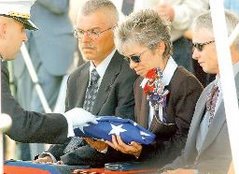
Minutes after her husband's casket arrived at the Reno airport, Katherine Cathey fell onto the flag. When 2nd Lt. James Cathey left for Iraq, he wrote a letter to Katherine that read, in part, "there are no words to describe how much I love you, and will miss you. I will also promise you one thing: I will be home. I have a wife and a new baby to take care of, and you guys are my world."Friday, June 1, 2007
The Bearers: 2006 Pulitzer Pictures of the Year
Minutes after her husband's casket arrived at the Reno airport, Katherine Cathey fell onto the flag. When 2nd Lt. James Cathey left for Iraq, he wrote a letter to Katherine that read, in part, "there are no words to describe how much I love you, and will miss you. I will also promise you one thing: I will be home. I have a wife and a new baby to take care of, and you guys are my world."The Bearers: 2nd Lt. Jim Cathey 1
Todd Heisler The Rocky Mountain News When 2nd Lt. James Cathey's body arrived at the Reno Airport, Marines climbed into the cargo hold of the plane and draped the flag over his casket as passengers watched the family gather on the tarmac. During the arrival of another Marine's casket last year at Denver International Airport, Major Steve Beck described the scene as one of the most powerful in the process: "See the people in the windows? They'll sit right there in the plane, watching those Marines. You gotta wonder what's going through their minds, knowing that they're on the plane that brought him home," he said. "They're going to remember being on that plane for the rest of their lives. They're going to remember bringing that Marine home. And they should."
In death, a hero
The flag never left Jim Cathey.
From the moment his body departed Iraq, the sturdy, heavyweight cotton flag remained nearby, following him from the desert to Dover Air Force Base, Del., where a mortuary affairs team received his body.
According to the Department of Defense, Cathey was killed in Al Karmah, Iraq, on Aug. 21. Members of his unit later told family members that Cathey was leading the search of an abandoned building when a booby-trapped door exploded. The explosion was so fierce it blew off an arm and leg of the Marine directly behind Cathey. That man, now in recovery, credits his lieutenant with saving his life.
Once Cathey's remains arrived at Dover, the mortuary affairs team began the delicate task of readying his body for the final trip home. When possible, military morticians prepare a body for viewing by the family. In Cathey's case, that wasn't an option.
Specialists at Dover wrapped his body in a white shroud and covered it with a satin body-length pillow and his dress blue uniform before closing the casket lid and securing the flag nearby.
When the plane landed in Reno, the same flag was draped over the casket, which was loaded into the hearse to continue its journey to the funeral home.
After all the noise at the airport - the screaming, the crying, the whining of jet engines - inside the funeral home each footstep echoed.
The pallbearers carried their friend's body to the front of an enormous empty room, then faded into the background. Beck posted himself at the head of the casket, his face frozen in the Marine stare.
His eyes trained forward, he still saw everything.
Inside the room, Cathey's mother, Caroline, bent down to hug Katherine. They squeezed each other for a long time.
"You give me strength," the young widow said.
Other family members sat on couches and some sat on the floor - hugging, holding hands, their eyes locked on the casket, for nearly half an hour.
Finally, Beck broke the silence.
"I'm sorry," he said, excusing the family from the room. "There are some things I need to do."
cont'd below
Cathey-2
Beck motioned to the pallbearers and began the instructions that would hold for the next three days.
Although the Marines are required to stand watch over a comrade's body, once the casket is safely inside a locked mortuary or church, they usually leave at night and return when the mortuary reopens.
This time, however, the watch would not end.
"Katherine and Caroline have both expressed concerns about Jim being left alone," Beck told the Marines. "So we won't leave him alone."
He then explained how to guard the casket. They all had posted watch before. They had stood at attention for hours as part of basic training, but nothing like this.
They were to take shifts of about an hour at a time, Beck instructed, standing watch 24 hours a day. When changing the guard, they were to salute Cathey's casket first, then relieve the other Marine the same way.
He showed them the slow salute - the one they aren't taught in basic training - three seconds up, hold for three seconds and three seconds down.
"A salute to your fallen comrade should take time," he said.
For Beck, that salute embodies more than the movement itself. Earlier in the day, someone had asked him about the arrival of "the body." He held up his hand with a firm correction.
"'The body' has a name." he said. "His name is Jim."
In the room, he walked up to the casket and paused.
"Now, this is important, too," he said. "If a family member wants you to break, you can break. They may want to hug you or kiss you. That's OK. Hug them. If someone wants to shake your hand, shake their hand. I'll take my glove off when I shake their hand - you don't have to, it's up to you. But then go back to position.
"Everyone understand?"
"Yes, sir," they responded. "Roger that."
"This is a serious business," he said. "Jim is watching you."
As the other Marines filed into the hallway, closing the door behind them, Beck walked back to the casket. For the first time, he and Jim Cathey were alone.
It was time for the final inspection.
more below
Cathey-3
Todd Heisler © News Marine Maj.Steve Beck prepares for the final inspection of 2nd Lt. Jim Cathey's body, only days after notifying Cathey's wife of the Marine's death in Iraq. The knock at the door begins a ritual steeped in tradition more than two centuries old; a tradition based on the same tenet: "Never leave a Marine behind."
No detail too small
Beck walked up to the casket and lifted the flag back, tucking it into neat pleats and leaving just enough room to open the heavy wooden lid. He walked around the flag several times, making sure each stripe lined up straight, smoothing the thick stitching with his soft white gloves.
Then he lifted the lid.
For the past five days, Beck had spent hours looking at pictures of Jim Cathey, listening to the family's stories, dabbing their tears. When he looked inside, they were no longer strangers.
For the next 10 minutes, Beck leaned over the open casket, checking the empty uniform that lay atop the tightly-shrouded body, making sure every ribbon and medal was in place. Occasionally, he pulled off a piece of lint or a stray thread and flicked it away.
Although casualty assistance officers receive an advisory from military morticians about whether a body is "viewable," some families insist on looking. The casualty assistance officer is often the one to make last-minute recommendations, since by then he knows the family and - after the final inspection - knows exactly what the family will see.
Whether or not the family decides on a viewing, Beck said, the procedure is no less meticulous.
In Cathey's case, the family decided not to look under the shroud. But Katherine wanted a few minutes alone with the open casket, to give her husband a few of the things they had shared - and one he never got to see.
Beck ran his hand alongside the shroud, taking one last look at the uniform.
He closed the lid and turned toward the door.
final post for Cathey below
Cathey-4

Since James Cathey was killed in a massive explosion, his body was delicately wrapped in a shroud by military morticians, then his Marine uniform was laid atop his body. Since Katherine Cathey decided not to view her husband's body, Maj. Steve Beck took her hand, and pressed it down on the uniform. "He's here," he said quietly. "Feel right here."
'I'm always kissing you, baby'
Katherine draped her body over the smooth wood, pressing her pregnant belly to the casket, as close to a hug as she could get.
Beck placed a hand on her back.
"Tell me when you're ready," he said. "Take your time."
He stepped back.
The air conditioner clicked on, filling the room with a low hum. Ten minutes passed. It clicked off, leaving the room to her soft moans.
She moved only to adjust her feet, continuing to rub her belly against the wood. She closed her eyes and whispered something.
Then she looked up at Beck.
"OK," she said.
As she stood at his arm, he opened the casket.
She didn't cry. She didn't speak. He gave her a few seconds, then took her hand and brought it to the middle of the empty uniform. He held her hand there and pressed down.
"He's here," he told her. "Feel right here."
She held her hand on the spot, pressing the uniform into the shrouded body beneath. She dragged her hand the length of all that was there.
Beck walked back to get the personal belongings Katherine had brought with her from Colorado.
"Where do you want to start?" he asked.
"With the picture of us kissing," she said.
She placed the picture at the top of the casket, above the neck of the uniform. She bent down and pressed her lips to it.
"I'm always kissing you, baby," she whispered.
She took several other photos of their lives together and placed them around the uniform. She gently added a bottle of her perfume, then picked up the dried, fragile flowers of her wedding bouquet.
Before Jim Cathey had left for officer training, they were married by a justice of the peace in Denver, planning a big wedding on his return from Iraq. Her wedding dress still hangs in her closet at home, unworn.
She placed the flowers alongside the uniform, then turned again to the major.
"The ultrasound," she said.
The fuzzy image was taken two days after her husband's death. Katherine had scheduled the appointment for a day when Jim was supposed to call, so they could both learn the baby's gender together. He had a feeling it was a boy, he had told her. If it was, she suggested they name the child after him.
She stood cradling the ultrasound, then moved forward and placed it on the pillow at the head of the casket. She stood there, watching for several minutes, then removed it.
She walked the length of the casket, then stepped back, still holding the only image of James J. Cathey Jr.
She leaned in and placed it over her husband's heart.
+ + +
Photos and article are a combination of two sources listed below.
Source-freerepublic and Source Rocky Mountain News
The Bearers and the Process
God bless them and all concerned.
D. M.
+ + +
From Marine Corps News Service
Sep 19 2004
1st Lt. Eric M. Knapp
Guide Note: While this story is from the United States Marine Corps, the casualty notification process of all of the services are almost exactly the same.
For serious injuries and death, the PCR is forwarded up the chain of command to the headquarters of the Marine Corps. A PCR contains a Marine's personal information: name, rank, social security number, unit, time and date of incident, extent of injuries, and where he is being treated at.
There is a balance, though, in including too little or too much information in the PCR the family receives.
"Our general's intent is not to provide information where the enemy can retrieve it and get an accurate assessment of the force they are inflicting on us," Rico said. "When we do our PCR everything is in general terms."
Understandably, some families want to know exactly when, where, why and how their son or daughter was injured.
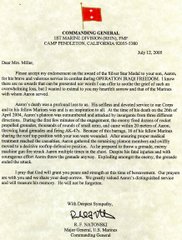
"That is where the unit comes into play," Rico explained. "The battalion commander, company commander or platoon commander will write a letter and explain exactly what happened to their son or daughter."
The Marine Corps has another crucial element to providing information to families and giving them comfort in their time of need, though.
"In cases of very serious injury or death, the (Marine Corps) will assign a CACO - a casualty assistance officer - to make notification to the family," Rico said.
"Many families do not know what's involved with getting a Marine home, getting therapies, or getting through medical facilities before he's discharged," Rico added. "Or they're not aware of how a deceased Marine is processed within the Marine Corps. That's where the CACO comes in."
The CACOs are Marines who are hand-picked from the Inspector Instructor staff stationed across the US, whose primary job is to train and instruct reservists. The CACOs are assigned to a family the minute the PCR is received and often stay in close contact until the family buries their loved one or is rehabilitated, as in the case of a severe injury.
CACOs can be sent out alone, in pairs or be a whole team. Chaplains often accompany them on the visits.
"They have refined the process to an art form," said Rico, who has served as a CACO. "Every single I&I staff knows we're out here and have their procedures in place and their designated CACOs. There's always gas in a van ready to go. Their Dress Blues are hanging up in their office ready to go. It's just amazing."