
At Agana Bay, a fisherman throws his talaya (throw net). Pre-war Guam was a society of subsistence. Farmers and fishermen secured their family's food for the day from the abundance of the sea and the fertility of the land.
###
Guam obstacle to Japan's ocean empire
By PAUL J. BORJA
In pre-World War II Guam, life was generally as it had been for decades. Except for the presence of those responsible for the naval administration of the island, Guam was basically a land of farmers and fishermen, the people living a simple lifestyle where they met their essential needs.
So when war came to this kind of community, this kind of society, it was devastating, bringing unstoppable change.
The first war to visit the island and its people came in the Spanish colonization. Though Ferdinand Magellan had come upon the island in 1521 and the explorer Legaspi had "claimed" Guam for the Spanish crown in 1565, it was only in 1668 that the Spanish attempted to colonize the isle.
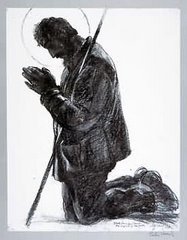
In that year, Guam found itself the focus of Catholic missionaries, notably the padre Luis de San Vitores, and their accompanying military protectors. The effort to bring Catholicism to the island was successful - today, the great majority of the people call themselves Catholics - but the price to Guam and its native people was costly. The resistance of the indigenous people to the Spanish resulted in conflict and war with the Spanish military. So by the time the United States came unto the island in 1898 in the aftermath of the Spanish-American War, the war of colonization and disease brought by Western man reduced the native Chamorro population from a high of perhaps as many as 100,000 people in 1668 to 9,000 by 1898.
By 1898, the people and the island were at peace, but both people and island were neglected by a Spain whose empire was fading into history. In spite of America's rise in power and influence around the world, the life of the people of Guam saw relatively little change in the transition from being one nation's colony to being a possession of another. A great part of the reason for that was the ambivalence, and ignorance, of the United States toward the Pacific and Oceania. As a result, of all the Spanish islands of the Marianas, only Guam was taken as a spoil of war under the Treaty of Paris between Spain and the United States. Spain retained the northern Mariana islands - Saipan, Tinian and others - and sold them to Germany in 1899.
Source





























No comments:
Post a Comment