Friday , April 06, 2007
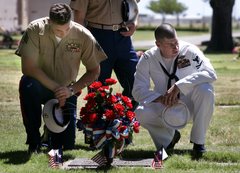
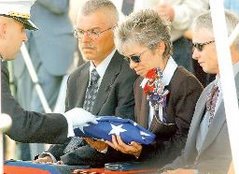
In an about-face by the U.S. government four years into the war in Iraq, America's fallen troops are being brought back to their families aboard charter jets instead of ordinary commercial flights, and the caskets are being met by honor guards in white gloves instead of baggage handlers with forklifts.
That change — which took effect quietly in January and applies to members of the U.S. military killed in Afghanistan, too — came after a campaign waged by a father who was aghast to learn that his son's body was going to be unloaded like so much luggage.
John Holley said an airline executive told him that was the "most expeditious" way to get the body home.
"I said, `That's not going to happen with my son. That's not how my son is coming home,"' said Holley, an Army veteran from San Diego whose son, Spc. Matthew Holley, was killed by a roadside bomb in Iraq in 2005. "If it was `expeditious' to deliver them in garbage trucks, would you do that?"
Kalitta Charters of Ypsilanti, Mich., won the Pentagon contract to bring the war dead home, and has returned 143 bodies since Jan. 1.
More than 3,500 Americans have been killed in Iraq and Afghanistan. Before the new law was passed by Congress, the dead that arrived from overseas at the military mortuary in Dover, Del., were then typically flown to the commercial airport nearest their families.
Some were met by smartly uniformed military honor guards. But in other cases, the flag-draped caskets were unceremoniously taken off the plane by ordinary ground crew members and handed over to the family at a warehouse in a cargo area.
Now, the military is flying the dead into smaller regional airports closer to their hometowns, so that they can be met by their families and, in some cases, receive community tributes. And the caskets are being borne from the plane by an honor guard.
Last year, the U.S. military spent about $1.2 million to bring home the dead on commercial flights. Switching to charter flights will cost far more: The six-month Kalitta contract is worth up to $11 million.
"It's so much more dignified, so much more a respectable way of getting them home," said Tom Bellisario, a Kalitta pilot who has flown more than 30 of the missions.
"It's definitely an honor for all of us," Bellisario said. "You figure the last time they saw that person they were alive. As soon as we pull the flag-draped casket into the doorway you hear the crying. You can sense it in the air."
Click here for full story.



























No comments:
Post a Comment